
There are two rather different stories in HMRC’s latest R&D tax relief statistics. The headline is that the total value of relief claimed has risen to £8.2 billion. Look beneath it, however, and the number of claims has more than halved since 2020/21, while the support claimed by SMEs has fallen for three consecutive years. Large companies, meanwhile, are claiming substantially more relief. Depending on which figures we choose to emphasise, the same publication can appear reassuring or troubling.
It would be convenient if there were one explanation. Perhaps stronger compliance has removed claims that should never have been made. Perhaps eligible businesses have been discouraged by the process. Or perhaps the figures reflect something wider, with smaller companies struggling to invest while economic activity becomes more concentrated in larger businesses. Each argument deserves consideration, but none should be treated as established simply because claim numbers have fallen.
What the figures show
The first table sets out the number of claims over the last five years, using HMRC’s latest figures and revisions to earlier years.
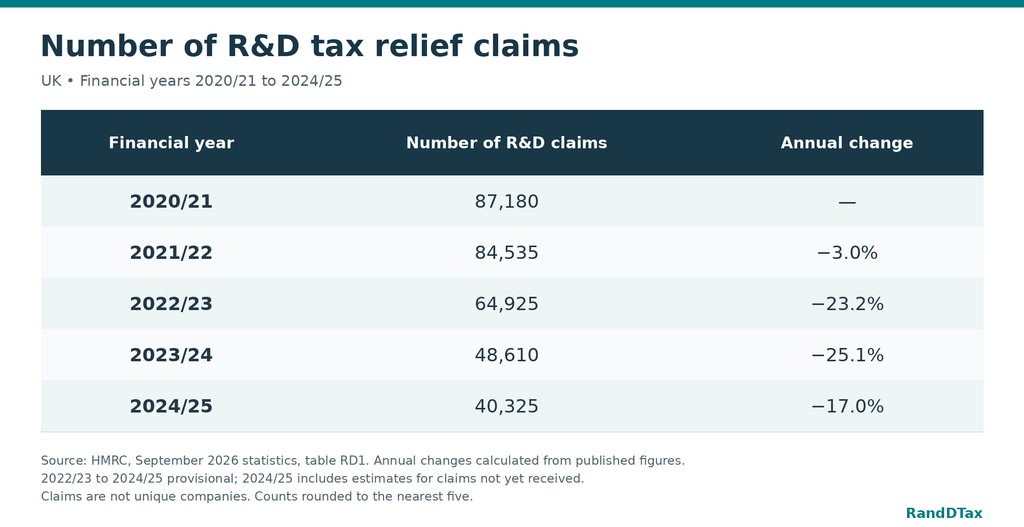
The decline amounts to 53.7% between 2020/21 and 2024/25. These are claims rather than unique companies, as a business can make more than one claim, but the scale of the change is substantial. The second table shows how the value of relief has moved over the same period. SMEs are counted across all schemes, including RDEC and merged RDEC, so that moving between schemes is not mistaken for leaving the system.
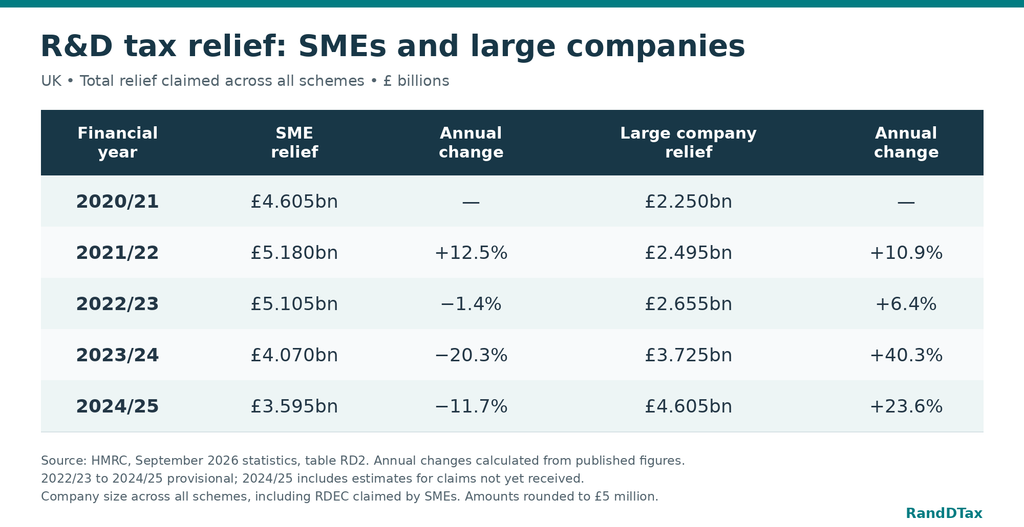
Across the full period, SME relief fell by 21.9%, while large company relief increased by 104.7%. Changes in relief rates help explain this divergence. For expenditure incurred from April 2023, the RDEC rate increased from 13% to 20%, while the SME enhancement and standard payable credit rate were reduced. The subsequent move to merged RDEC, for accounting periods beginning on or after 1 April 2024, reduced support further for some SMEs, particularly profitable companies previously benefiting from the enhanced deduction. These changes affect the amount claimed even where the underlying R&D activity continues, so the figures reflect both changing participation and changing levels of support.
A correction, or a harder decision to claim?
The case for viewing the decline as a correction is straightforward. R&D tax relief should support work that meets the statutory requirements. If stronger scrutiny and submission controls cause unsupported or ineligible claims to disappear, that is an intended outcome. HMRC identifies the continuing impact of the Additional Information Form as a likely contributor to falling claim numbers. Requiring businesses to explain their projects and expenditure can encourage a more careful assessment before a claim reaches the tax return.
The difficulty is knowing how much of the decline this explains. A business that stops claiming does not necessarily concede that its previous claims were wrong. Its circumstances may have changed, or it may have decided that the expected benefit no longer justifies the work involved. For a smaller claim, the time needed to gather evidence, establish expenditure and prepare the submission can weigh heavily against the tax saving. Changes in relief rates can make that balance less attractive still.
There is also the question of confidence. A company may have undertaken qualifying work but be uncertain about explaining it, allocating costs or responding to a possible enquiry. Some businesses will seek advice and proceed with a better supported claim; others may decide against committing the management time. Stronger compliance can therefore improve the quality of claims while also making the decision to claim more difficult. The national totals do not separate those effects.
Procedural deadlines add another possible explanation. Where claim notification is required, missing the deadline can prevent a claim even if the work qualifies. A business that first considers R&D relief when preparing its accounts may discover the opportunity too late. That is a different reason for a missing claim from either technical ineligibility or a commercial decision that the benefit is too small, although all three can produce the same result in the statistics.
Could the decline reflect a wider economic problem?
A more concerning interpretation is that the figures may reflect financial pressure on smaller businesses and a weakening appetite for investment. The argument would be that, in an economy under severe strain, an SME is more likely to concentrate on paying staff, keeping customers and protecting cash than committing resources to development with an uncertain return. A project might be postponed, reduced or abandoned before there is expenditure to claim. Under that interpretation, falling participation would partly reflect less R&D being undertaken, rather than simply fewer businesses seeking relief for it.
There is a related concern about companies that continue developing products and processes but do not claim. SMEs can contribute to growth through new businesses, specialist technologies, employment and competition. If eligible firms are missing support because they lack advice, miss a deadline or find the process too demanding, the consequences could extend beyond the immediate tax saving. Less cash available for the next development project could affect the business’s ability to grow. This is a plausible argument, although the figures do not tell us how many companies are in that position.
The rise in large company relief makes the question more pressing, but it does not answer it. More support reaching larger businesses might finance valuable research, skilled jobs and stronger supply chains. Alternatively, critics might ask whether some of that relief subsidises expenditure that would have happened anyway, without generating enough additional investment or growth to justify the increasing cost. A larger tax relief total is not, by itself, evidence of a stronger economy or a more successful incentive. Equally, it is not evidence that large companies are failing to deliver. Assessing that requires information about what the support changes and what results follow, which these tables do not provide.
Several explanations may be operating together
Scheme changes further complicate the picture. The increase in the RDEC rate and reductions in the old SME rates affect the distribution of relief. Changes to the rules for contracted out R&D can also alter which company within a supply chain is entitled to claim. Alongside those changes, projects finish, businesses close or change direction, and some former claimants have no qualifying activity in a later year. It would be surprising if a change of this scale had only one cause.
My view: the importance of consistent compliance
Since I started advising on R&D claims in 2013, most of my experience has been with SMEs. I have seen smaller businesses face demanding enquiries and interpretations of eligibility that, in my view, have become more restrictive without corresponding changes to the underlying law in recent years. Anecdotal evidence suggests that some large companies have experienced a more accommodating approach, although my experience does not provide a comprehensive comparison.
One experience that has stayed with me was an unsuccessful bid to advise on a substantial claim for the UK arm of a major global company in a sector strongly associated with R&D. My impression from that process was that the company did not expect the detailed compliance work I considered necessary for SME claims, and that there was greater scope for informal agreement with HMRC. I was not appointed, so my understanding of the subsequent handling was necessarily limited.
That apparent contrast concerns me. SMEs can face extensive demands for records and evidence which, in my view, sometimes go beyond what is reasonable. A prolonged dispute can be particularly difficult for a smaller business, leaving it more vulnerable to pressure to accept a decision or abandon a sound claim. Entitlement should be assessed against the same legal principles, regardless of a company’s resources to challenge HMRC.
I would therefore be cautious about interpreting falling SME participation and rising large company relief as evidence of successful compliance. Stronger controls are necessary, but success should also mean that eligible businesses can access support and that the law is applied fairly, regardless of company size. If HMRC applies a more accommodating interpretation of the same legal requirements to large companies than to SMEs, that cannot be right. There should not be two classes of claimant. The £4.6 billion claimed by large companies is taxpayers’ money and deserves scrutiny every bit as rigorous as the £3.6 billion claimed by SMEs.
For an individual company, the starting point remains a careful assessment of its projects, expenditure and deadlines. If you would like help understanding whether your work qualifies, preparing a claim or dealing with an HMRC enquiry, contact RandDTax.
Christopher Toms MA MAAT
Compliance Director RandDTax
This article is an opinion piece for general information and does not constitute tax, legal or other professional advice. The treatment of any R&D claim depends on its particular facts and circumstances. Professional advice should be obtained before taking action.
Source: HMRC, Research and Development Tax Credits Statistics, September 2026, tables RD1 and RD2. Percentages calculated from the published rounded figures. Figures for 2022/23 to 2024/25 are provisional; 2024/25 includes estimates for claims not yet received. Amounts are rounded independently to £5 million. The release covers accounting periods ending in the financial years shown, with both old and new schemes represented in 2024/25.