
HMRC made an interesting change to its Corporate Intangibles Research and Development Manual on 25 August 2026. The change concerns CIRD151000 and the circumstances in which expenditure on R&D undertaken overseas can still qualify for R&D tax relief.
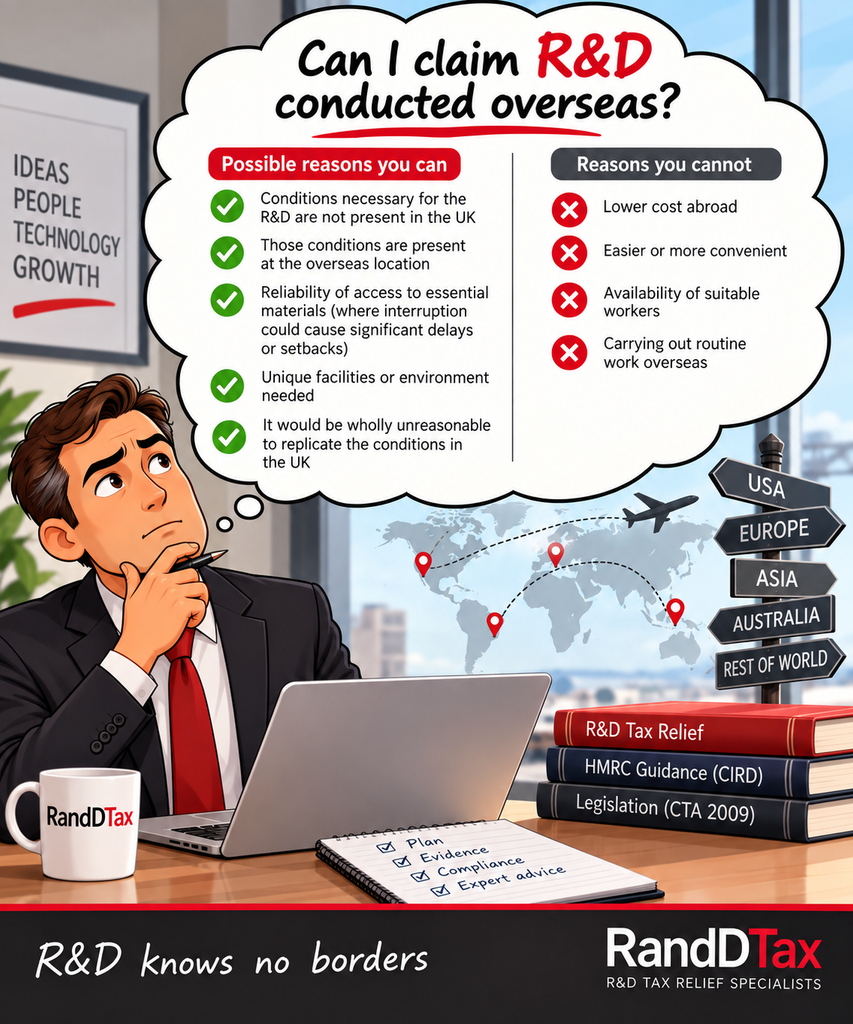
Under the rules applying to the merged RDEC and ERIS schemes, expenditure on R&D undertaken overseas through contractors and externally provided workers is generally restricted. There is, however, an exception where conditions necessary for the R&D are not present in the UK, are present where the overseas R&D takes place, and it would be wholly unreasonable for the company to replicate those conditions in the UK.
HMRC previously included “environmental sustainability” amongst its examples of geographical, environmental and social conditions. This included examples such as the carbon impact of shipping materials or equipment long distances, the choice to use green energy or the ability to recycle waste.
On 25 August 2026 that guidance changed. HMRC's amendment history describes this as a redraft of the penultimate bullet under “Geographical, environmental and social conditions”.
The new guidance instead refers to the reliability of access to materials essential to the R&D, where interruption in supply is a real possibility and could cause significant delays or setbacks to the work.
This is potentially useful, but it should not be read as a new standalone rule allowing overseas R&D simply because specialist materials are more reliably available there.
A company may, for example, be able to rely on the reliability of access to a specialist material where interruption in supply is a real possibility and could cause significant delays or setbacks to the R&D. However, the company must still satisfy the statutory test. The relevant condition must be necessary for the R&D, absent from the UK, present where the overseas R&D takes place, and one which it would be wholly unreasonable for the company to replicate in the UK.
Simply finding it cheaper to undertake the R&D overseas is not enough. Neither is the availability of suitable workers. Both the cost of the R&D and the availability of workers are expressly excluded by the legislation.
What happened to environmental sustainability?
It is also interesting that environmental sustainability has disappeared from HMRC's examples.
That does not establish that environmental sustainability can never constitute a relevant condition. The legislation itself includes geographical, environmental and social conditions, and HMRC makes clear that the examples in CIRD151000 are not exhaustive.
What has changed is that a claimant can no longer point to HMRC's former explicit example covering matters such as carbon impact, green energy and recycling. Anyone seeking to rely on environmental sustainability would therefore need to consider carefully whether the particular circumstances satisfy the statutory test rather than simply relying upon that former example in CIRD.
Do not forget what a CIRD is.
There is a wider point here which is worth remembering whenever HMRC changes its manuals.
CIRD is HMRC's Corporate Intangibles Research and Development Manual. It contains HMRC's interpretation of the legislation and is an extremely useful source when preparing R&D claims. It is not, however, the legislation itself.
This amendment illustrates that distinction rather neatly. One example has disappeared and another has replaced it, while the underlying legislation has not changed.
HMRC guidance should therefore be read carefully, but alongside the legislation rather than treating every sentence in CIRD as though it were itself law. It is also a reminder of the dangers of relying upon an old copy of the guidance. R&D tax relief has changed substantially in recent years and HMRC continues to update CIRD.
You can read the current HMRC CIRD151000 guidance and HMRC's CIRD amendment history.
If your company undertakes R&D overseas using contractors or externally provided workers, the rules need to be considered carefully. RandDTax can advise on whether overseas expenditure qualifies and, importantly, whether the evidence is strong enough to support the position taken in the claim.
Contact RandDTax for R&D tax claim advice
Christopher Toms MA MAAT
Compliance Director
RandDTax
Disclaimer: This article is an opinion piece provided for general information only. It reflects the author's views and understanding at the date of publication and does not constitute tax, accounting, legal or other professional advice. R&D tax relief depends on the particular facts and circumstances of each company and claim. You should obtain appropriate professional advice before taking, or refraining from taking, any action based on the contents of this article.