
In my previous blog I looked at how much an R&D tax claim is really worth in 2026. Once you understand the value of a claim, the next logical question is what is a fair fee to pay for preparing it.
This is not always as straightforward as it first appears.
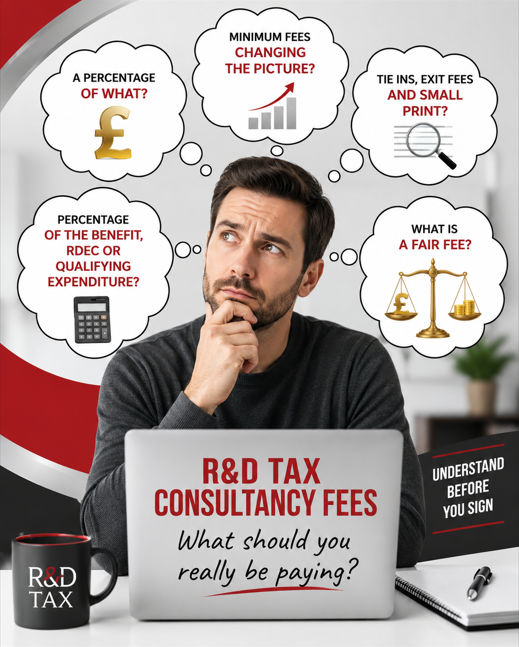
Many companies compare advisers purely on the percentage fee being quoted. Unfortunately, percentages on their own tell you very little. Two consultancies can both advertise the same percentage, yet one could cost significantly more than the other depending on how that percentage is calculated and contractual fine print.
The first question every claimant should ask is a simple one.
A percentage of what?
That one question can save a business thousands of pounds. My last blog looks at R&D claim benefit.
The Percentage Is Only Part of the Story
Many R&D consultancies charge a percentage fee, but there is no universal basis for calculating it.
The most transparent approach is to charge a percentage of the actual benefit received by the company. If your company receives £100,000, a 10% fee is easy to understand. You know exactly what you are paying and what you are keeping.
However, not every consultancy calculates fees this way.
Some charge a percentage of the RDEC itself. While the percentage quoted may appear lower, the company never actually receives the full RDEC because Corporation Tax has to be paid before the benefit reaches the business. A fee based on the gross RDEC can therefore represent a much higher percentage of the money that ultimately ends up in your bank account.
Others charge a percentage of the qualifying expenditure. Again, this may sound attractive when comparing percentages, but it is not directly comparable with a fee based on the benefit of the claim.
The result is that businesses often believe they are comparing like with like when they are not.
Which is better 5%, 10% or 12%?
£100,000 qualifying expenditure a fee based on 5% of this is £5,000. The RDEC rate is 20%, the RDEC is £20,000 but it is taxed at either 19%, 25%, or 26.5%. Lets say 25% tax applies, the company gets £15,000 but after the fee £10,000. The fee is actially 33% of the benefit!
So lets look at a 10% of the RDEC fee, the RDEC is £20,000 the fee is £2,000. The company gets a benefit of £15,000 after the fee it is £13,000. The fee on the benefit is 13.33%
The last one is easy the benefit is £15,000 the fee 12% leaving £13,200.
Before comparing fee percentages, make sure you understand exactly what the percentage is being applied to it is very important. Some fee propositions are structured to look low but you are not comparing the same things.
Minimum Fees Can Change Everything
Another area that deserves careful attention is the minimum fee.
There is nothing inherently wrong with minimum fees. Smaller claims still require professional work, technical analysis and compliance procedures. A consultancy has costs regardless of claim size.
The problem arises when businesses focus only on the headline percentage.
Imagine an adviser quotes a fee of 10% with a minimum fee of £6,000.
At first glance that sounds competitive.
However, if your claim delivers a benefit of £20,000, you will not pay £2,000. You will pay the £6,000 minimum fee, which is effectively 30% of your benefit.
The advertised percentage has become almost irrelevant.
Always ask what you are likely to pay in pounds, not just in percentages.
What Is a Fair Percentage?
This is probably the question I am asked most often.
The honest answer is that there is no single correct percentage.
Suppose a claim generates a benefit of £1 million. A 15% fee would amount to £150,000. Most businesses would rightly question whether that represents good value.
Now consider a claim worth £5,000. A 15% fee would be only £750. Once you consider the technical work involved, client meetings, report preparation, calculations, professional review, insurance, compliance procedures and ongoing support, that fee is unlikely to be commercially viable for the adviser.
This is one reason minimum fees exist.
It is also why comparing percentage fees in isolation rarely gives the full picture.
Why We Quote Bespoke Fees
At RandDTax we prefer to understand the claim before quoting.
The likely value of the claim, the quality of the company's records, the complexity of the projects and the level of support required all influence the work involved.
That allows us to provide a fee that reflects the circumstances rather than forcing every client into the same pricing model.
We also recognise that different businesses value different things.
Some clients want a comprehensive service that includes a no win no fee arrangement and support through any future HMRC compliance check.
Others are comfortable taking on more of that risk themselves in exchange for a lower fee.
Rather like choosing extras when booking a flight, removing certain elements of the service can reduce the overall cost. The important point is that clients should understand exactly what is included and what is not before making a decision.
Read the Small Print Before You Sign
The fee itself is only one part of the commercial arrangement. Before appointing an adviser, take the time to read the engagement terms carefully.
Some contracts contain lengthy tie in periods, automatic renewals or exit fees that can make it expensive to move to another adviser. Others include additional charges for services that many clients assume are included as standard, such as dealing with an HMRC compliance check.
There is nothing wrong with an adviser protecting their business with sensible contractual terms, but those terms should be transparent and clearly explained. If you find yourself struggling to understand the agreement, ask questions before signing. A reputable adviser should be happy to explain exactly how their fees work, what services are included and under what circumstances additional costs might arise.
The importance of understanding the small print was highlighted in the widely reported “£10 billion fridge” story, which centred on R&D tax consultancy arrangements. Whatever your view of the case, it is a reminder that the headline fee is only one part of the agreement. The contractual terms matter just as much.
If you have not read the story, it is well worth doing so before signing any engagement letter with an R&D adviser.
The £10 Billion Fridge: The Full Story
Consider More Than Just the Fee
Cost is important, but it should never be the only consideration.
The quality of the technical work, the experience of the adviser, their understanding of HMRC's current approach and the support available if questions are raised after submission can all be worth far more than saving a small percentage on the initial fee.
Equally, do not be afraid to negotiate. A published fee is not always the only fee available, particularly where claims are larger or where the circumstances are straightforward. The right adviser should be willing to discuss a fee that reflects the work involved rather than simply applying a standard percentage.
As a minimum, make sure you understand what the percentage is calculated on, whether there are minimum fees, whether additional charges may arise later and whether there are contractual commitments that could make it difficult or expensive to leave.
An R&D tax claim can provide valuable funding for your business. Choosing the right adviser is about far more than finding the lowest headline percentage. It is about understanding exactly what you are paying for and making sure there are no surprises later.
If you would like an honest discussion about what your claim might be worth and what a transparent, bespoke fee would look like for your circumstances, we would be pleased to help.
Contact us here:
Christopher Toms MA MAAT
Compliance Director
RandDTax